Hard Water from a Private Well: Signs, Test Results, and the Best Treatment Options
- Hard Water from a Private Well: Signs, Test Results, and the Best Treatment Options
- What “Hard Water” Means for Well Owners
- Signs of Hard Water from a Private Well (What You’ll Notice First)
- How to Test for Hard Water from a Private Well
- Understanding Well Water Test Results (Hardness and the “Neighbors”)
- Best Treatment Options for Hard Water from a Private Well
- Choosing the Right System Size (Avoiding the Two Common Mistakes)
- Key Takeaways
- Conclusion: Solving Hard Water from a Private Well the Right Way
Hard Water from a Private Well: Signs, Test Results, and the Best Treatment Options
If you rely on a well, Hard Water from a Private Well: Signs, Test Results, and the Best Treatment Options is more than a “comfort” topic—it affects plumbing longevity, appliance life, soap performance, and even how your water tastes. In many parts of the United States, groundwater naturally picks up calcium and magnesium as it moves through rock and soil, so hard water is common in rural areas. The good news: once you confirm hardness with the right testing, treatment is straightforward and highly effective.
This guide walks you through field signs, how to read well-water test results, and the treatment options that make the most sense for real-world well systems.
What “Hard Water” Means for Well Owners
Hard water is water with elevated dissolved minerals—primarily calcium (Ca) and magnesium (Mg). Hardness is usually reported as mg/L (ppm) as CaCO3 or grains per gallon (gpg).
- Soft: 0–60 mg/L (0–3.5 gpg)
- Moderately hard: 61–120 mg/L (3.6–7 gpg)
- Hard: 121–180 mg/L (7.1–10.5 gpg)
- Very hard: >180 mg/L (>10.5 gpg)
Practical insight: On private wells, hardness often changes seasonally. After long dry spells or heavy irrigation draw, mineral concentration can rise because the aquifer recharge pattern shifts.
Signs of Hard Water from a Private Well (What You’ll Notice First)
Well owners often detect hardness from performance issues around the home long before they ever run a lab test. Common signs include:
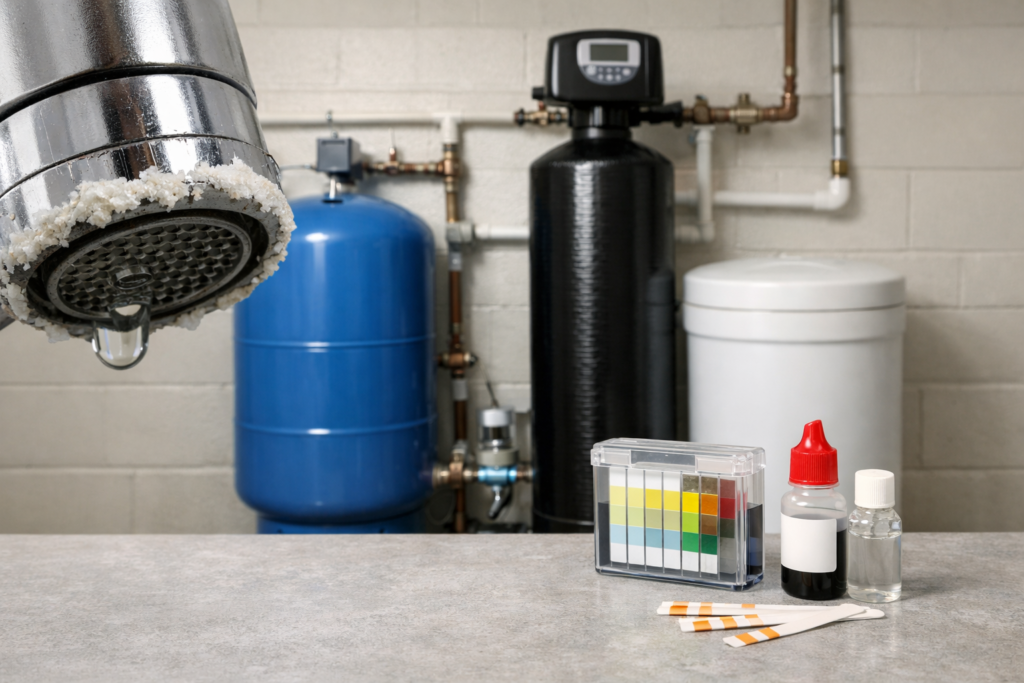
- White scale on faucets and showerheads (crusty buildup that’s hard to wipe off)
- Spots on dishes and glassware even after drying
- Soap that won’t lather and a “film” feeling after showers
- Stiff laundry, fading fabrics, and gray/“dingy” whites
- Reduced water flow at fixtures due to scale narrowing aerators and valves
- Shorter appliance life (water heaters, dishwashers, washing machines)
Practical insight: If you have a tank-style water heater and notice popping or rumbling, that can be scale insulating the heating surface. It’s not just noise—it’s wasted energy and accelerated heater wear.
How to Test for Hard Water from a Private Well
To confidently address Hard Water from a Private Well: Signs, Test Results, and the Best Treatment Options, start with testing. You have three solid routes:
1) Quick at-home hardness strips (screening)
Strips are inexpensive and fine for a first look. They’re less precise, but they can confirm whether you’re in the “hard/very hard” range.
2) Drop titration kit (better accuracy)
A drop kit gives you a clearer number in gpg or ppm. Many well professionals use this for sizing softeners.
3) Certified lab test (best for treatment planning)
A lab panel is ideal because it can identify related issues that change your treatment approach (like iron, manganese, pH, tannins, and hydrogen sulfide).
Sampling tip: Pull water from a cold-water tap before any existing treatment equipment (if possible). If you only test after a filter/softener, you might miss what’s actually coming from the well.
Practical insight: If your home has a whole-house cartridge filter, test once with a fresh cartridge and once near end-of-life. A clogged filter can reduce flow and be mistaken for scale-related restriction.
Understanding Well Water Test Results (Hardness and the “Neighbors”)
Hardness rarely travels alone. These common companion results matter because they can change equipment selection and maintenance:
- Iron (Fe): Can stain fixtures and laundry; can foul softener resin if not handled properly.
- Manganese (Mn): Dark staining; more stubborn than iron at low levels.
- pH: Low pH can be corrosive; high pH can worsen scaling behavior.
- TDS: Total dissolved solids; high TDS may suggest broader mineral load.
- Hardness as CaCO3: The main number used to size softeners and set regeneration.
Practical insight: Don’t size a softener based on hardness alone if iron is present. A common field rule is to add “compensated hardness” (for example, counting each 1 ppm of iron as several grains of hardness) so the system is not undersized.
Best Treatment Options for Hard Water from a Private Well
There’s no one-size-fits-all solution. The “best” option depends on your hardness level, household water use, plumbing materials, and whether iron/manganese are in the mix.
Whole-house ion exchange water softener (gold standard)
For most homes, a properly sized ion exchange softener is the most reliable fix. It swaps calcium and magnesium for sodium (or potassium, if you choose potassium chloride).
- Best for: Hard to very hard water affecting the entire home
- Pros: Consistent results; protects plumbing and appliances; improves soap performance
- Cons: Adds sodium/potassium; requires salt refills; creates brine discharge
Well-system note: Place the softener after the pressure tank and typically after sediment filtration. If you have noticeable sand/silt, a sediment prefilter can prevent valve wear.
Practical insight: Use a softener with a metered (demand-initiated) valve rather than a timer when possible. Wells often have variable usage patterns; metered regeneration reduces salt and water waste.
Salt-free “conditioners” (TAC/Template Assisted Crystallization)
Salt-free systems don’t remove hardness minerals; they change how minerals behave so scale is less likely to stick.
- Best for: Moderate hardness where scale reduction is the main goal
- Pros: No salt, no brine discharge, minimal maintenance
- Cons: Not true soft water; soap/lather improvements are limited; performance varies with water chemistry
Practical insight: TAC media can struggle if iron or manganese is present or if prefiltration isn’t adequate. A lab test helps you avoid paying for a “solution” that can’t work with your well’s chemistry.
Point-of-use reverse osmosis (RO) for drinking and cooking
RO is excellent for improving taste and reducing dissolved solids at one faucet, but it’s not a whole-house scale solution by itself.
- Best for: Drinking water improvements, especially when TDS is elevated
- Pros: High-quality water for consumption
- Cons: Slower production; waste stream; membranes foul faster with hard water
Best practice: Pair RO with a whole-house softener (or at least soft water feeding the RO) to protect the membrane and extend filter life.
Scale control for water heaters (supporting treatment)
If hardness has already caused buildup, consider maintenance steps alongside your main treatment:
- Flush tank-style water heaters periodically (frequency depends on hardness and sediment)
- Clean faucet aerators and showerheads to restore flow
- Consider a professional descaling for heavily scaled systems
Practical insight: If your home has recirculation plumbing (common in larger rural homes), scaling can accelerate because hot water repeatedly concentrates minerals. Softening becomes even more cost-effective in recirc setups.
Choosing the Right System Size (Avoiding the Two Common Mistakes)
The best equipment still fails if it’s sized or programmed incorrectly. Two frequent issues we see in the field:
- Undersizing the softener: Leads to frequent regeneration, higher salt use, and “hardness breakthrough.”
- Over-softening everything: Some homeowners prefer to leave an unsoftened cold-water line to an outdoor spigot or a kitchen tap (depending on preference and local considerations).
To size correctly, you need:
- Hardness level (and iron/manganese if present)
- Household occupancy and water use habits
- Peak flow needs (showers, laundry, irrigation tie-ins)
Key Takeaways
- Hard Water from a Private Well: Signs, Test Results, and the Best Treatment Options starts with confirming hardness (ppm or gpg) and checking related chemistry like iron and pH.
- Scale, spots, poor soap lather, and reduced flow are the most common household clues.
- A metered ion exchange softener is usually the most effective whole-house solution for well owners.
- Salt-free conditioners can help with scale but don’t provide “true” soft water.
- RO is best as a point-of-use upgrade—often paired with softening to protect the membrane.
Conclusion: Solving Hard Water from a Private Well the Right Way
If you’re dealing with scale, spotting, and underperforming appliances, dealing with hard water from a private well comes down to two steps: test accurately and match the treatment to your well’s chemistry and household demand. In most U.S. well homes, a properly sized metered softener—often with smart prefiltration when sediment or iron is present—delivers the best long-term protection for plumbing, fixtures, and water-using equipment.
For ongoing confidence, retest your well water periodically (and after any major pump work, flooding, or drought) so your treatment stays aligned with what your well is actually producing. And always check with a licensed professional to make sure your water is clean and safe.