How Often Should You Pump Your Septic Tank? (The Complete Guide)
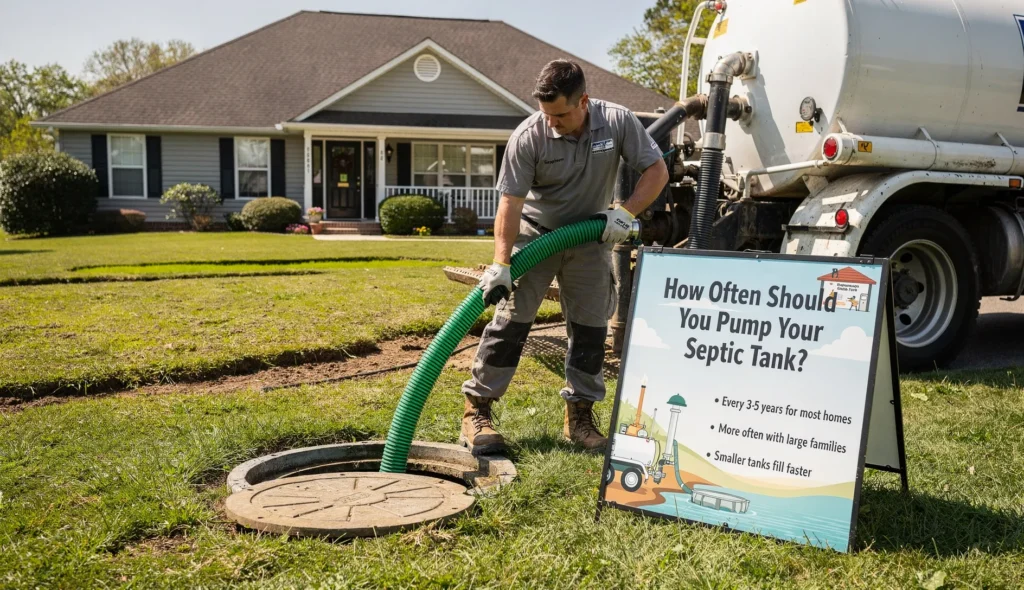
If you’re one of the roughly 60 million Americans who rely on a septic system, there’s one maintenance task you absolutely cannot skip: pumping your tank. But how often should you pump your septic tank? The answer depends on several factors — and getting it wrong can lead to thousands of dollars in repairs or a complete system replacement.
How Often Should You Pump? The General Rule
The EPA recommends that most household septic tanks be inspected at least every three years and pumped every three to five years. For the average family of four with a 1,000-gallon tank, pumping every three to four years is a solid baseline.
But that number isn’t one-size-fits-all. Your pumping schedule depends on four key factors:
Household size. More people means more water usage and more solids entering the tank. A couple living alone might go five years between pumpings, while a family of six may need it every two years.
Tank size. Septic tanks typically range from 750 to 1,500 gallons. Smaller tanks fill up faster and need more frequent attention. If you’re not sure of your tank’s size, your pumping contractor can tell you during a service visit.
Total wastewater generated. High water usage — from long showers, frequent laundry loads, or running the dishwasher daily — accelerates how quickly your tank fills. Fixing leaky faucets and toilets can meaningfully extend the time between pumpings.
Volume of solids in wastewater. Households that use garbage disposals send significantly more solids into the tank, which can cut your pumping interval in half. If you have a garbage disposal, plan on pumping every two to three years.
Septic Tank Pumping Frequency by Household Size
Here’s a practical reference based on tank size and number of people in the home:
- 1–2 people, 1,000-gallon tank: Every 4–5 years
- 3–4 people, 1,000-gallon tank: Every 2–3 years
- 5–6 people, 1,000-gallon tank: Every 1–2 years
- 3–4 people, 1,500-gallon tank: Every 3–4 years
- 5–6 people, 1,500-gallon tank: Every 2–3 years
These are estimates. Your septic professional can measure the sludge and scum layers during an inspection and give you a more precise recommendation.
Warning Signs You Need to Pump Your Septic Tank Sooner
Don’t wait for a disaster. Watch for these red flags that your tank is overdue:
Slow drains throughout the house. If multiple sinks, tubs, or toilets are draining slowly at the same time, your tank is likely full. (Learn all 10 warning signs of septic failure.)
Sewage odors. Foul smells near the tank, drain field, or inside the house mean gases are escaping because the system is overwhelmed.
Standing water or soggy ground near the drain field. When the tank is too full, liquid waste can surface in your yard — a clear sign of system stress.
Sewage backup. This is the worst-case scenario. If wastewater backs up into your home, your tank is critically overdue for pumping.
Unusually green grass over the drain field. While a lush lawn sounds nice, extra-green patches directly over your septic components usually mean wastewater is fertilizing the soil at the surface level.
What Happens During a Septic Pumping?
The process is straightforward and usually takes about 30 to 60 minutes. A licensed technician arrives with a vacuum truck, locates your tank’s access lid (or lids), and pumps out all the contents — liquid, sludge, and scum.
A good contractor will also inspect the tank during the process, checking for cracks, leaks, or damage to baffles and filters. They should give you a written report of the tank’s condition and an estimate of when you’ll need the next pumping.
Expect to pay between $300 and $600 for a standard pumping, depending on your location, tank size, and accessibility. It’s one of the most affordable investments you can make to protect a system that costs $15,000 to $30,000 to replace.
How to Extend the Time Between Pumpings
A few simple habits can help your septic system work more efficiently:
Spread out laundry loads. Instead of doing all your laundry on Saturday, run one load per day to avoid overwhelming the system with water.
Fix leaks promptly. A single running toilet can waste 200 gallons per day — all of it flowing into your septic tank.
Skip the garbage disposal. Compost food scraps instead. Garbage disposals dramatically increase the solids in your tank.
Use water-efficient fixtures. Low-flow toilets, showerheads, and faucet aerators reduce the total volume of water entering your system.
Be careful what goes down the drain. Never flush wipes (even “flushable” ones), feminine products, cat litter, cooking grease, or harsh chemicals. These either clog the system or kill the beneficial bacteria that break down waste. (See the full list of things you should never flush.)
The Bottom Line
Regular septic pumping isn’t optional — it’s essential preventive maintenance that protects your home, your property value, and your wallet. Mark your calendar, keep records of every service visit, and when in doubt, call a local septic professional for an inspection.
Need to find a septic pumping service near you? Search our directory of verified providers to compare ratings and connect with trusted pros in your area.